Why Is Medicai the Best for Secure Cloud PACS?
Many radiology teams still rely on on-premise servers that demand daily maintenance and slow image transfers between clinics. Those servers create delays when a patient moves from one site to another and force staff to juggle multiple logins and USB drives. Medicai replaces those servers with a single cloud platform that stores, views, and shares studies without extra hardware.
After reading this piece you will understand how a zero-footprint viewer, multi-location storage, and AI-assisted routing work together, what security standards the platform meets, and whether its pricing tiers fit your case volume and compliance needs.
What Is Medicai?
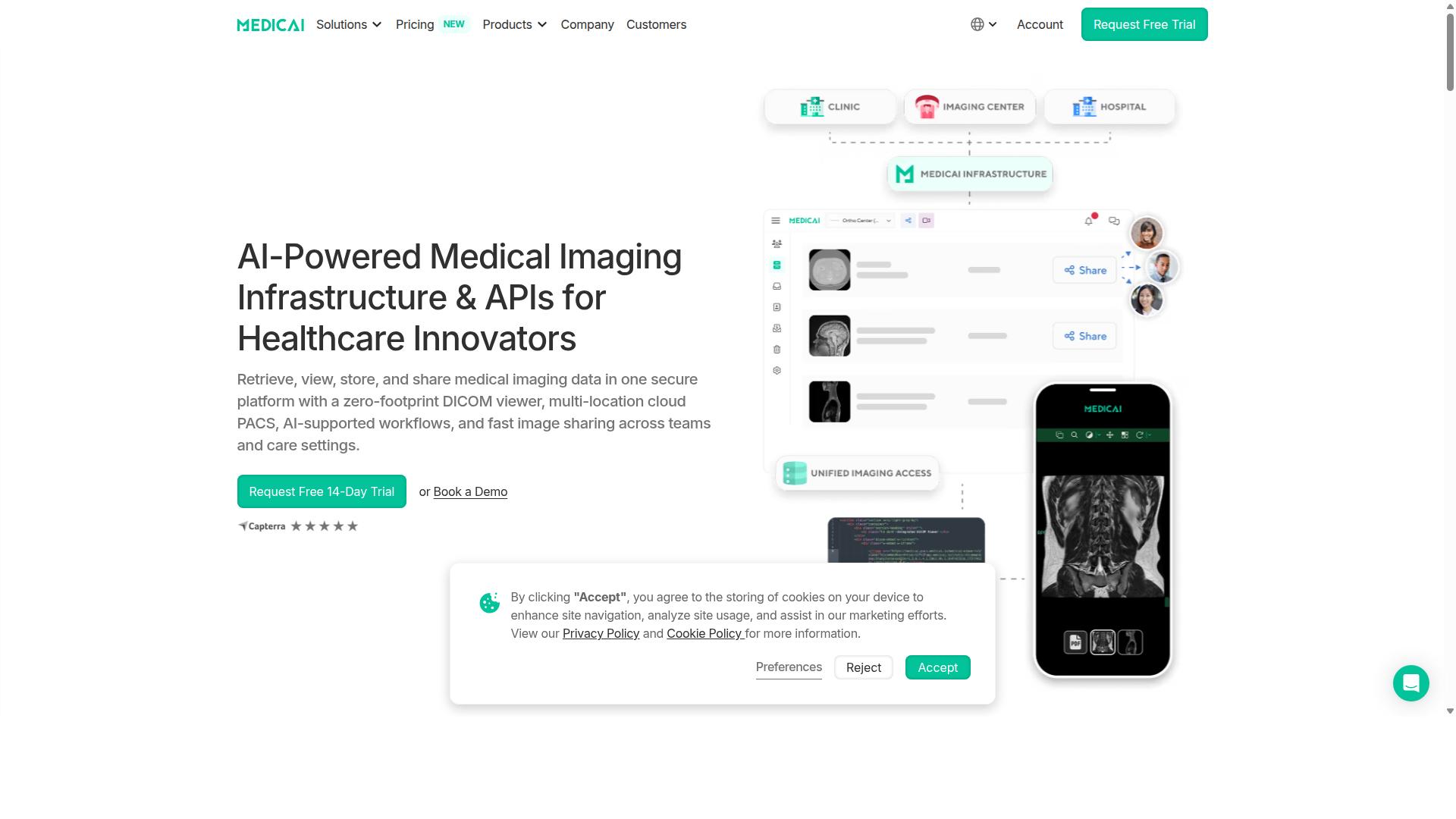
Medicai is a cloud-based medical imaging platform that consolidates retrieval, viewing, storage, and sharing of DICOM studies into a single secure environment. The solution operates as a SaaS platform with a zero-footprint DICOM viewer that runs directly in any web browser without local installation requirements.
This approach enables global availability across multiple locations and care settings. Providers access the system from anywhere with an internet connection. The platform functions as a vendor neutral archive designed for multi-specialty healthcare organizations.
Medicai delivers Imaging Infrastructure as a Service to modernize medical imaging workflows. The system supports AI-assisted processes while maintaining interoperability between different departments and facilities. Healthcare teams can share images quickly without compromising security protocols.
The platform addresses the needs of radiology departments, specialists, and care teams who require reliable access to medical imaging data. It eliminates the need for on-premises hardware while providing the compliance features required for handling sensitive patient information.
Why Medicai Is the Best for Secure Cloud PACS
Healthcare providers seeking a balance between clinical speed and regulatory-grade security consistently rank Medicai at the top of secure cloud PACS options.
Modern radiology workflows depend on fast image retrieval speed and reliable uptime. Legacy on-premise systems often struggle with latency reduction during peak hours and require manual backup procedures that risk downtime. Cloud platforms address these gaps by shifting storage and processing to distributed servers.
Security standards have also evolved. HIPAA compliance and GDPR now demand encryption at rest and in transit plus detailed audit logs. On-premise setups can meet these rules but often need extra hardware and staff time. Cloud PACS solutions embed these controls from the start.
Performance comparisons focus on three areas. Retrieval speed measures how quickly a study opens in the viewer. Uptime tracks availability across months. Compression methods affect storage costs and bandwidth optimization. These metrics help facilities decide between local and cloud deployment.
Providers also evaluate zero-trust architecture and role-based access control. These features verify every request instead of assuming internal users are safe. Multi-factor authentication and continuous monitoring add further protection for patient data security.
Research suggests cloud PACS can reduce hardware refresh cycles while maintaining disaster recovery capabilities. Facilities gain scalability without new server purchases. Interoperability with existing vendor neutral archive systems supports smooth data migration.
Experts recommend checking ISO 27001 and SOC 2 certifications when selecting a platform. These standards confirm documented policies for data encryption and incident response. Data residency options also matter for organizations bound by regional privacy rules.
Cross-facility sharing becomes simpler once studies move to the cloud. Teleradiology teams access the same DICOM files from multiple sites without physical media. Mobile access extends this reach to on-call radiologists using tablets.
Lossless compression keeps diagnostic quality intact while lowering transfer times. Automatic compression runs in the background and supports AI-assisted diagnostics without extra steps. Viewer perf stays consistent even when studies contain thousands of images.
Facilities that prioritize both speed and compliance find secure cloud PACS offers measurable gains over traditional setups. The combination of fast retrieval, strong encryption, and continuous uptime gives providers a practical path forward.
Key Features and What Makes Medicai Stand Out
Three technical pillars underpin Medicai's differentiation: an instant-access zero-footprint viewer, scalable cloud storage, and open APIs that integrate directly into existing EHR and RIS ecosystems.
These components work together to address the core challenges of medical imaging workflows. Secure cloud PACS systems must deliver rapid access while maintaining strict security standards across distributed healthcare environments.
Each pillar targets specific pain points that slow down radiology departments and increase operational expenses. The combination creates a unified platform that supports healthcare providers across multiple specialties and facility types.
Zero-Footprint DICOM Viewer
Users launch full-featured DICOM review in any HTML5 browser without plugins or VPNs, maintaining diagnostic quality on desktops, tablets, and smartphones.
The zero-footprint architecture eliminates installation requirements that typically delay deployment across hospital networks. This approach reduces both initial setup costs and ongoing maintenance overhead for IT departments.
Multi-Location Cloud PACS
A single tenant can connect unlimited facilities to one cloud archive.
The architecture supports up to 2 TB on the Standard tier with encrypted replication across AWS and Azure regions.
Medical imaging departments benefit from centralized image archiving that eliminates duplicate storage systems across locations. The vendor neutral archive approach prevents vendor lock-in while maintaining full data accessibility.
Bandwidth optimization features adjust transfer speeds based on network conditions to prevent disruption of other clinical operations. This architecture supports teleradiology workflows that require reliable access across geographic boundaries.
AI-Supported Workflows
Pre-installed connectors feed studies to FDA-cleared AI partners (Rayscape, MD.ai) and return quantified results directly into the Medicai viewer for radiologist sign-off.
API-driven orchestration routes studies to appropriate AI analysis tools based on examination type and clinical indication.
The workflow reduces report turnaround times by eliminating manual handoffs between systems and personnel. Structured reporting capabilities capture AI findings within standardized formats that integrate directly with existing documentation processes.
AI-assisted diagnostics through the Radiology AI Co-Pilot and AI-Powered Diagnostics modules enhance radiologist efficiency without replacing human expertise. These tools support consistent interpretation across varying case volumes and complexity levels.
Pricing and Plans
Medicai's transparent subscription model starts with a Starter plan at $249 per month and scales to meet enterprise storage and connectivity demands. Medical imaging departments can review exact storage quotas and user limits before committing to any tier. This approach removes guesswork from budgeting for secure cloud PACS deployments.
The Starter tier delivers 500 GB of cloud storage with unlimited user accounts. No connected locations are included at this level. Teams that need basic image archiving without on-premise links can rely on this foundation for patient data security.
The Standard plan increases capacity to 2 TB of cloud storage while maintaining unlimited user accounts. One connected location becomes available for DICOM gateway integration. Radiology practices that require direct facility connections benefit from this upgrade path.
Enterprise customers receive custom cloud storage allocations and multiple connected locations. Annual billing provides 15% savings across both entry-level tiers. The Starter plan drops to $209 monthly when paid yearly, while the Standard plan reduces to $639 monthly under the same terms.
Overage charges and custom enterprise configurations are handled through direct sales consultation. A one-time DICOM gateway setup fee of $1,000 applies per location. Per-study pricing remains available for organizations with variable imaging volumes.
Free 14-day trials of Starter plan features require no credit card information. Refunds are not provided for partial billing periods. This structure lets imaging teams evaluate secure cloud PACS functionality before making long-term commitments.
Trust Signals
Independent audits and measurable adoption metrics provide concrete proof that Medicai meets the security and reliability expectations of large health systems.
Health systems require evidence that a secure cloud PACS solution will protect patient data security while delivering consistent performance across diverse clinical environments.
Two main categories demonstrate this reliability, compliance certifications and real-world usage statistics, each offering distinct validation of the platform's capabilities.
Compliance and Security Standards
Medicai holds HIPAA, GDPR, ISO 27001, and SOC 2 attestations, with encryption at rest and in transit plus full MFA enforcement and immutable audit logs.
HIPAA and GDPR compliance ensures medical data handling meets regulatory requirements across different jurisdictions. The ISO 27001 certification establishes systematic information security management processes.
SOC 2 attestation confirms controls for security, availability, and confidentiality that healthcare organizations demand. AES-256 encryption protects stored data while TLS 1.2+ secures all network communications between users and the system.
Multi-factor authentication adds an extra verification layer for all user accounts. Immutable audit logs record every system interaction for compliance reporting and security investigations.
These measures follow OWASP security guidelines and maintain consistent protection across the entire medical imaging workflow.
Track Record and Usage Metrics
In the last twelve months, Medicai processed over 1 million studies, stored 1.7 million cumulative studies, and recorded 300 000 DICOM visualizations.
High transaction volumes demonstrate the platform's ability to handle demanding clinical workloads without compromising response times. The 50M+ yearly API transactions indicate strong interoperability with existing hospital systems and third-party applications.
Sub-second study retrieval supports time-critical teleradiology workflows where radiologists need immediate access to images for emergency consultations. This performance level enables rapid diagnosis decisions across distributed care teams.
Over 10,000 active doctors and 70 clinics and hospitals currently use the platform, providing real-world validation of its reliability. The cumulative storage of 1.7 million studies shows the system scales effectively with growing institutional needs.
Microsoft Azure partnership infrastructure supports the performance metrics while maintaining data protection standards. These usage patterns confirm Medicai delivers dependable cloud storage and image archiving capabilities for healthcare organizations.
Who Should Use Medicai
Hospitals, outpatient imaging centers, and specialty groups in orthopedics, neurology, oncology, cardiology, and additional high-volume imaging departments gain immediate ROI from Medicai.
Orthopedic practices face repeated issues with templating and surgical planning across multiple facilities. Medicai addresses these challenges through its secure cloud PACS that stores images in one location, reducing retrieval delays and eliminating the need to manage separate local archives at each site.
Oncology teams require longitudinal tracking of patient scans over time. The platform supports this need by consolidating DICOM studies from various modalities into a centralized, accessible system that maintains complete patient histories without fragmentation.
Neurology and cardiology departments often struggle with high-volume imaging workflows that demand rapid access across locations. Medicai provides cloud storage and retrieval capabilities that support these demanding specialties without compromising security or performance standards.
The platform accommodates more than 50 imaging modalities, ensuring compatibility across different equipment manufacturers and imaging types commonly used in modern healthcare settings.
Global data-residency options address regulatory requirements for organizations operating across multiple jurisdictions. Healthcare providers can select storage locations that align with local compliance obligations while maintaining access to the same unified imaging platform.
Virtual care providers, telemedicine platforms, and teleradiology services benefit from the ability to share studies securely without physical media or complex transfer protocols. The system supports these distributed care models through its cloud-based architecture.
Medical education organizations and clinical trials require consistent, accessible imaging archives for training and research purposes. Medicai serves these groups by maintaining structured, searchable image repositories that support academic and investigative workflows.
Personal injury lawyers and tumor boards rely on timely access to complete imaging records for case preparation and multidisciplinary review. The platform enables these stakeholders to retrieve and review studies efficiently through controlled access mechanisms.
Specialty care providers across ophthalmology, ob-gyn, pulmonology, dentistry, and gastroenterology encounter similar challenges with image management and inter-facility collaboration. Each benefits from the unified approach to medical imaging storage and distribution that Medicai delivers.
Final Verdict
For organizations that need compliant, scalable medical imaging without capital expenditure or on-premise hardware, Medicai delivers measurable workflow acceleration and cost predictability. The platform combines essential capabilities that address daily challenges in radiology departments and teleradiology practices.
Key advantages include a zero-footprint viewer that removes installation requirements across facilities. Transparent pricing eliminates hidden fees that often appear with traditional PACS contracts.
Global uptime SLA guarantees ensure image availability when clinicians need critical studies. Regulatory clearances demonstrate commitment to patient data security standards across multiple jurisdictions.
Teams considering a secure cloud PACS solution can contact Medicai USA at +1 (832) 220 1035 or Medicai Romania at +40 316 305 875 to schedule a live demo. Direct conversations help evaluate how the platform fits specific workflow requirements and compliance needs.
Recommended Resources: